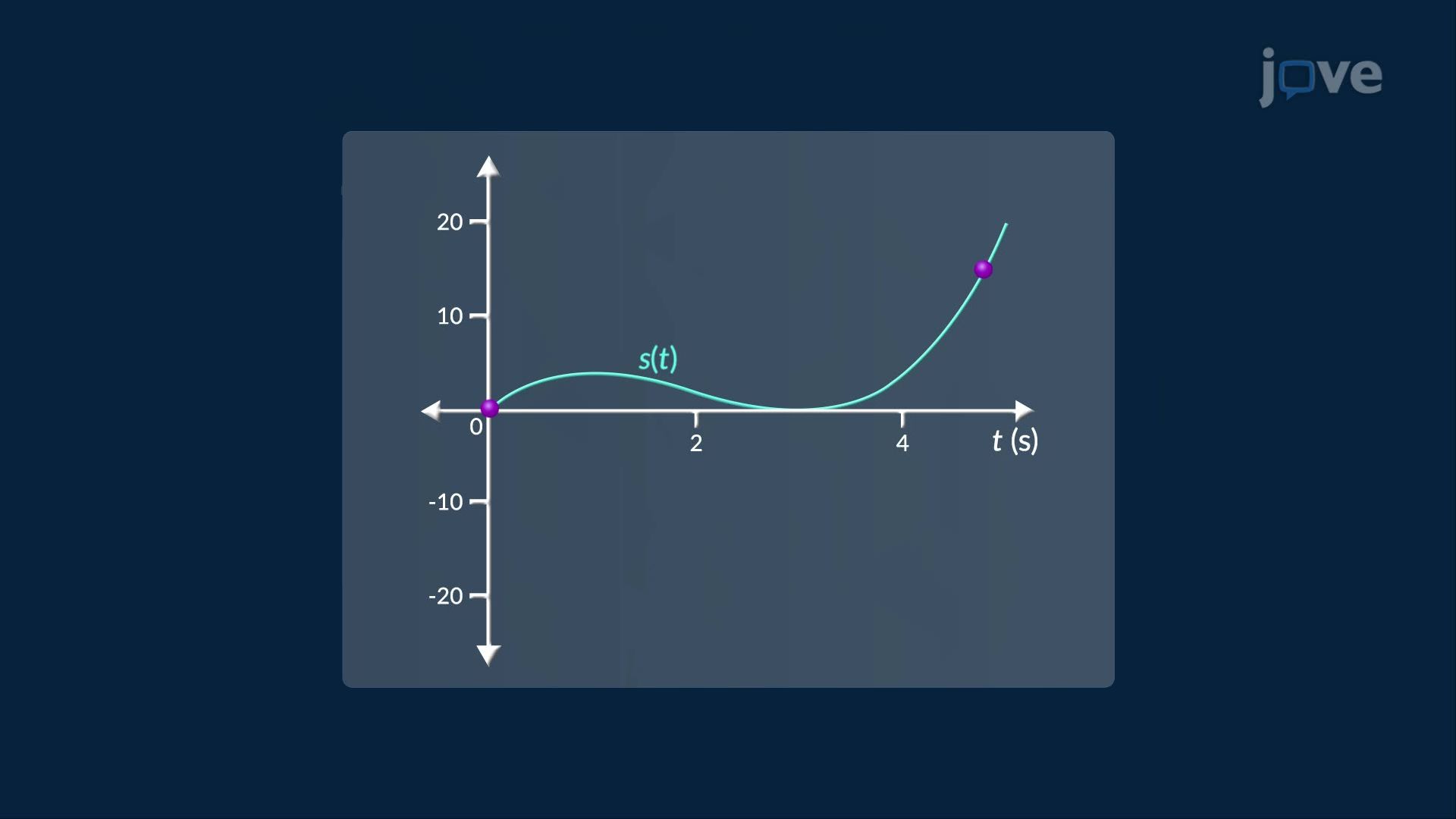
Definite integrals are essential tools in calculus, used to quantify accumulated change over an interval. A common physical application is calculating the total displacement from a velocity-time graph. If a velocity function, v(t), describes the motion of an object over time, the definite integral gives the net displacement between times a and b. This integral corresponds to the signed area under the velocity curve between those two points.
Two fundamental properties of definite integrals aid in simplifying such calculations: the additivity property and the constant multiple property. The additivity property states that if a continuous function is integrated over adjacent intervals, the sum of these integrals equals the integral over the combined interval. Mathematically, for a < c < b,

This is particularly useful when analyzing motion over segmented intervals, such as a car’s journey divided into different phases. It allows one to compute displacement piecewise and sum the results.
The constant multiple property expresses that scaling a function by a constant scales the integral by the same factor. For a constant, c,

This property is especially relevant when considering uniform changes in velocity—such as doubling the speed throughout the trip—which results in a proportional increase in total displacement. Together, these properties streamline the application of definite integrals in practical scenarios, such as kinematic analysis.
Definite integrals measure accumulation, such as total displacement from a velocity-time curve. Certain properties simplify these calculations, including additivity and the constant multiple properties.
For example, a car traveling at varying speeds has its total displacement shown by the area under the velocity-time curve.
When the trip is divided into segments, the additivity property of definite integrals becomes useful.
Suppose the car travels from a to c, and then from c to b, with a continuous velocity function.
The total displacement from a to b is found by integrating the velocity from a to c, and then adding the integral from c to b.
This shows that the definite integral from a to b equals the sum of the integrals over the adjacent intervals.
Another key property is the constant multiple property. This applies when the car’s velocity is scaled.
When the original velocity is doubled for the whole trip, the total displacement—the area under the curve—is also doubled.
This means the integral of a constant times a function equals the constant multiplied by the integral of that function.

 繁體中文
繁體中文