Bacterial generation time, the period required for a bacterial population to double during its exponential growth phase, serves as a critical measure of microbial growth dynamics under optimal conditions. This parameter varies significantly across bacterial species and can be influenced by factors such as temperature, pH, and the availability of nutrients. For example, Escherichia coli can achieve a generation time of approximately 20 minutes, while Mycobacterium tuberculosis exhibits a much longer doubling time, ranging from 12 to 24 hours.
Calculation of Generation Time
The generation time, denoted as g, can be calculated using the formula:
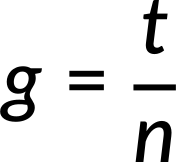
where t represents the total growth time in minutes, and n is the number of generations occurring during this time. Determining n, the number of generations, involves the equation:
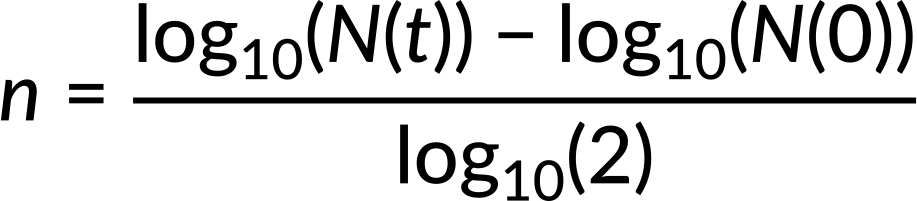
Here, N(0) is the initial population size, and N(t) is the population size after time t.
Application Example
Consider a bacterial culture starting with 1,000 cells and growing to 64,000 cells over a period of 3 hours (180 minutes). The number of generations can be calculated as:

Using this value of n in the generation time formula gives:
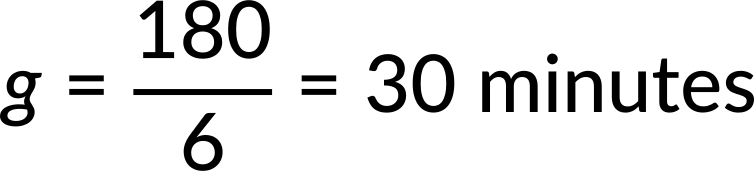
This example illustrates that under these specific growth conditions, the bacterial population doubles every 30 minutes.
Understanding generation time is essential for microbiological studies, particularly in areas like infection control, bioprocessing, and environmental microbiology, as it provides insights into the reproductive potential and adaptability of bacterial species under varying conditions.
Generation time is the period required for a bacterial population to double during the exponential growth phase. It reflects the speed of bacterial growth under optimal conditions.
The generation time varies among species and depends on environmental factors such as temperature, pH, and nutrient availability.
For instance, Escherichia coli has a generation time of about 20 minutes, whereas Mycobacterium tuberculosis can take up to 12-24 hours.
For bacterial growth, generation time, g, equals t divided by n. Here, t is the total time of growth in minutes, and n is the number of generations that occur during time t.
Another formula is used to determine the number of generations, where N(0) is the initial number of cells and N(t) is the final number of cells.
For example, if a bacterial culture starts with 1,000 cells and grows to 64,000 cells over 3 hours or 180 minutes, the number of generations would be calculated to be 6.
Substituting this value in the earlier formula gives the generation time of 30 minutes.

 繁體中文
繁體中文


