Cofunction identities are a key concept in trigonometry. They describe how trigonometric functions relate when their input angles are complementary — meaning the angles add up to 90°. On the unit circle, every angle θ— measured counterclockwise from the positive x-axis — corresponds to a point with coordinates (cos θ, sin θ). These values represent the horizontal and vertical components of the terminal side of the angle.
If the same point on the unit circle is instead described using the complementary angle 90° − θ, the reference changes to the positive y-axis. In this case, the horizontal segment that was originally adjacent to θ becomes the side opposite to 90° - θ, while the vertical segment that was opposite becomes adjacent. Thus, the coordinates can equivalently be expressed as (sin(90°− θ), cos(90° − θ)). Since both coordinate descriptions refer to the same point, it follows that:

These equalities are the basic cofunction identities, which illustrate how sine and cosine interchange roles for complementary angles.
In addition to sine and cosine, the same reasoning applies to other trigonometric functions, giving the complete set of cofunction identities:
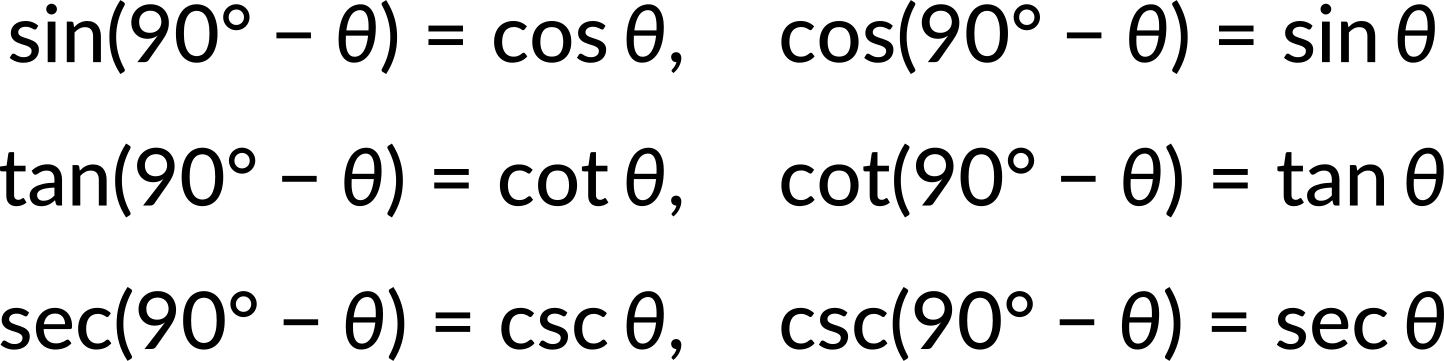
These identities demonstrate the symmetry of trigonometric functions and their deep connection to complementary angles in right triangles and the unit circle. They provide a systematic way to transform between functions when working with angles measured from different reference directions.
Cofunction identities describe how pairs of trigonometric functions relate when their angles add up to 90 degrees.
The two basic cofunction identities can be proven by considering a point on the unit circle.
Let theta be an angle with the positive x-axis. By definition, the x and y coordinates are then cosine theta and sine theta, respectively.
For the same point, measure its angle from the positive y-axis, 90 degrees minus theta.
The point coordinates are equal to sin 90 minus theta and cos 90 minus theta.
Since the coordinates are unchanged, equating the expressions proves the cofunction identities for sine and cosine.
However, all other trigonometric functions, which are based on sine and cosine, inherit this property.
These identities help in real-world calculations.
For example, when a boat is far from a lighthouse, the distance is measured using the angle of elevation from the moving boat to the top of the lighthouse. Cofunction identities allow replacing the Tangent of theta with the Cotangent of the complementary angle in the distance formula, preserving the result with flexibility in calculations.

 繁體中文
繁體中文


