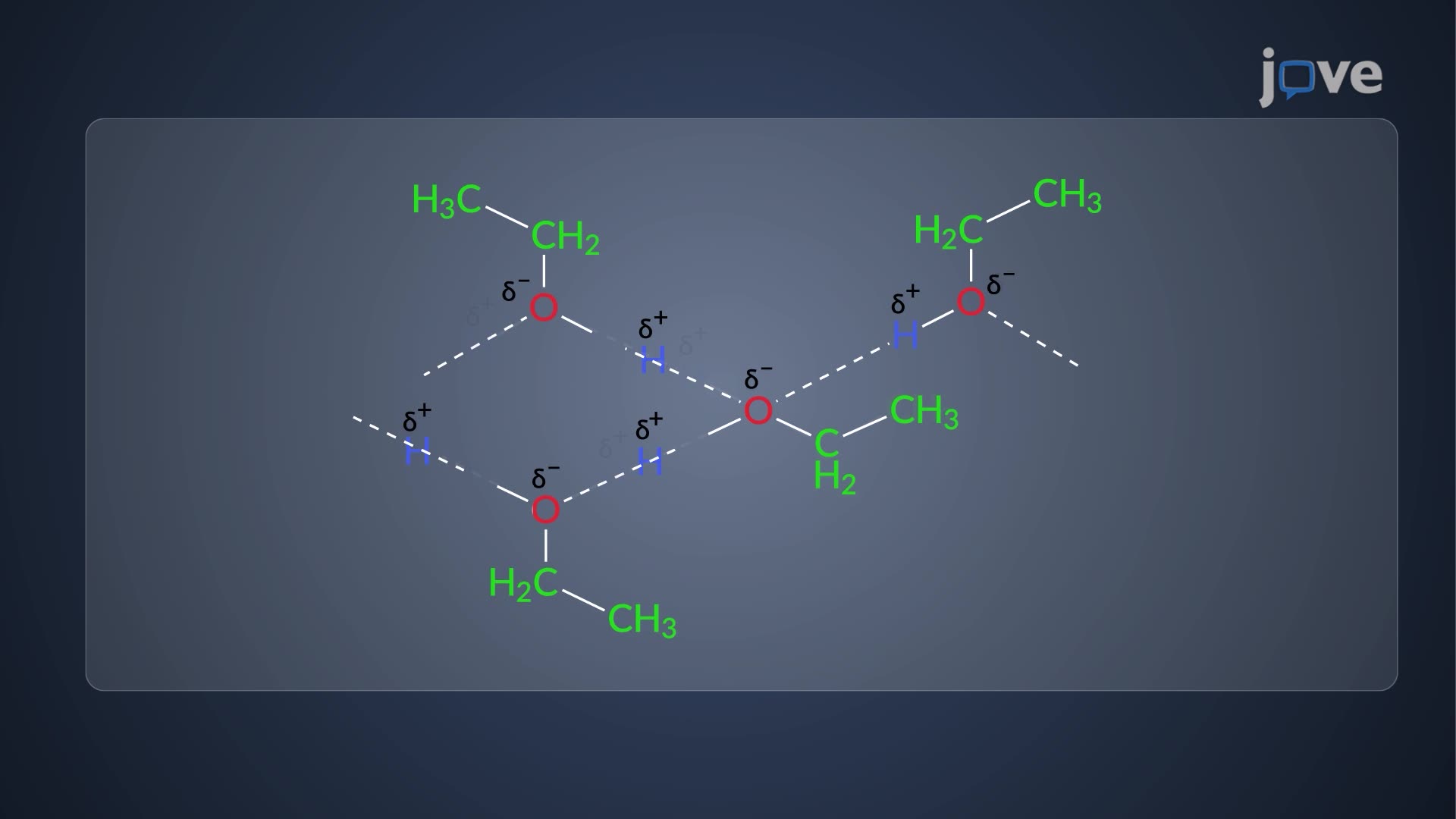
The vibrational frequency of a bond is directly proportional to its bond strength. As a result, stronger bonds vibrate at higher frequencies, while weaker bonds vibrate at lower frequencies. The stretching vibration of the strong O–H bond in alcohols and phenols (very dilute solution or gas phase) appears as a sharp peak at 3600–3650 cm−1.
However, the extent of hydrogen bonding influences the observed stretching frequency and band broadening. Intermolecular or intramolecular hydrogen bonding weakens the O–H bond, resulting in a range of bond strengths (3300–3400 cm−1). So, the hydrogen-bonded O–H stretching vibration in concentrated solutions appears as a broad signal in IR spectroscopy. In moderately dilute solutions, the sharp signal from the free O–H stretching appears beside the broad signal from the hydrogen-bonded O–H.
When the presence of bulky groups prevents hydrogen-bonding interactions, a sharp band is seen irrespective of the alcohol or phenol's physical state. Similarly, molecules exhibiting intramolecular hydrogen bonding show a broad band independent of concentration. For instance, ortho-carbonyl substituted phenols exhibit a broad signal at 3200 cm−1 at all concentrations.
In carboxylic acids, intermolecular hydrogen bonding between two molecules leads to the formation of dimers. The O–H band appears as a very broad peak (2400–3400 cm−1) centered at ≈3000 cm−1.
Recall that the vibrational frequency of a bond is proportional to the square root of the force constant, considering only bond strength effects and not reduced mass factors.
Thus, stronger bonds with higher force constants vibrate at higher frequencies upon IR absorption. Weaker bonds vibrate at lower frequencies.
For instance, intermolecular hydrogen bonding observed in alcohols and phenols weakens the existing O–H bond, thereby influencing the position of the characteristic O–H peak.
In a very dilute solution or gas phase, the absence of intermolecular H-bonds results in a sharp peak at ≈3600 cm−1.
In concentrated solutions, as the molecules are involved in varying degrees of H-bonding , there results in a very broad band in the range of 3200–3550 cm−1.
In moderately dilute solutions, both sharp and broad peaks are observed corresponding to the free and H-bonded O–H vibrations, respectively.
Moreso, the presence of bulky groups prevents H-bonding interactions, generating only a sharp peak irrespective of the physical state of the alcohol or phenol.

 繁體中文
繁體中文