Logarithmic functions are powerful tools for simplifying the mathematical representation of phenomena involving exponential changes. Their ability to convert multiplicative relationships into additive ones is especially valuable in various scientific and engineering contexts. One notable application of logarithms is measuring sound intensity, specifically through the decibel (dB) scale used in acoustics.
Sound intensity levels vary over an extensive range, from the faintest audible whisper to the roar of a jet engine. To manage this range and express it more practically, acousticians use the decibel scale, a logarithmic scale that quantifies sound intensity level relative to a reference value. The sound intensity level (SIL) in decibels is calculated using the equation:
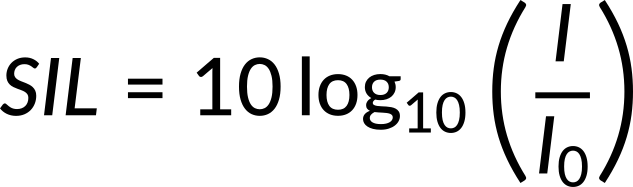
where I is the intensity of the sound and Io is the reference intensity, typically 10−12 W/m² for air. This formula compresses the range of sound intensities into manageable values and facilitates easier comparison and interpretation.
Because of the logarithmic scale, every 10 dB increase means a tenfold increase in sound intensity. Thus, a sound measuring 80 dB is ten times more intense than one at 70 dB. Such compression is essential in practical settings, including environmental noise monitoring, audio engineering, and hearing studies, where understanding relative changes in intensity is more relevant than absolute values.
Logarithmic representation in acoustics mirrors its utility in other domains by transforming complex, wide-ranging data into accessible, interpretable formats crucial for analysis, decision-making, and communication.
Logarithms help analyze equations involving exponential changes by turning multiplication into simpler addition.
They are especially useful when working with powers or with very large and small numbers.
Common examples include measuring seismic intensity and pH levels.
In chemistry, pH levels are determined using the pH scale, which uses logarithms to measure acidity or basicity.
The pH of a solution is calculated as the negative base-10 logarithm of the hydrogen ion concentration, measured in moles per liter.
This mathematical relationship allows extremely small concentrations to be expressed using more accessible numbers.
Importantly, acidity follows a power law: every one-unit change in pH corresponds to a tenfold change in hydrogen ion concentration. This shows how logarithms help describe power laws in nature.
The logarithmic scale compresses hydrogen ion concentration ranging from 1 mol/L to 10⁻¹⁴ mol/L into values between 0 and 14.
Such compression enables meaningful comparisons and a clearer interpretation of chemical behavior.

 繁體中文
繁體中文


