Trigonometric identities are equations that relate trigonometric functions and hold for all angles within their domains. A fundamental identity among these is the Pythagorean identity, which arises directly from the geometry of the unit circle. For any angle θ, a point on the unit circle has coordinates (cos θ, sin θ), and since the radius of the circle is one, the Pythagorean Theorem gives:

This identity serves as the basis for deriving additional identities. Dividing the Pythagorean identity by cos2θ (assuming cos θ ≠ 0) yields:
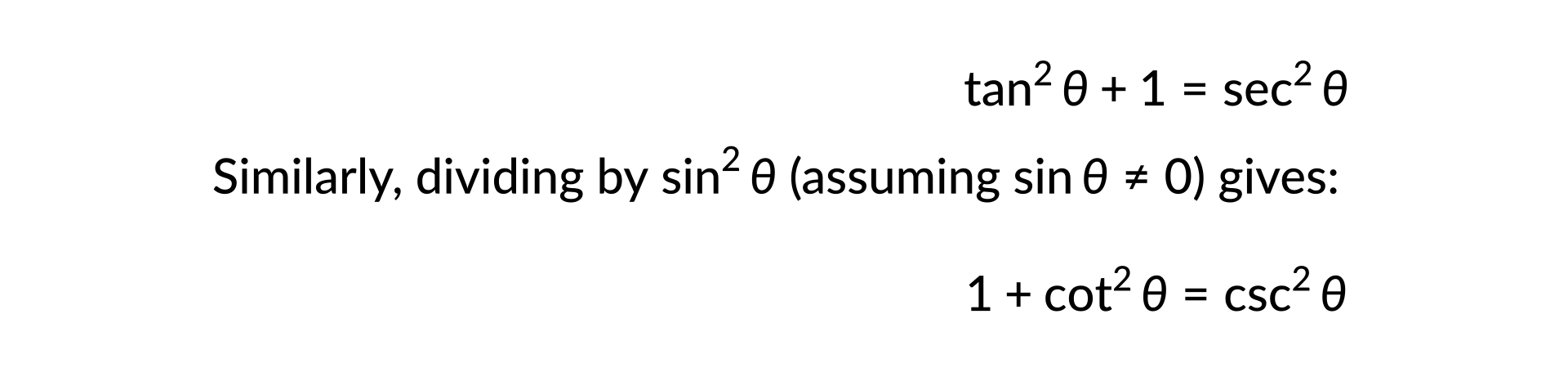
The Pythagorean identity also plays a role in more complex identities, such as the cosine addition formula. One method of deriving this formula involves geometric arguments using points on the unit circle and the distance formula. In this derivation, the coordinates of key points involve combinations of sine and cosine values. When applying the distance formula and simplifying, the Pythagorean identity reduces expressions involving the squares of trigonometric terms. This ultimately leads to:

By replacing t with -t in the addition formula and using the even and odd properties of cosine and sine, the subtraction formula is obtained:

The sine addition and subtraction formulas can also be derived using cofunction identities and angle transformations:

Finally, the tangent addition and subtraction identities are derived from the sine and cosine sum formulas by taking their ratio:

These identities are essential tools in algebraic simplification, solving trigonometric equations, and calculus applications
A trigonometric identity is an equation involving trigonometric functions that is true for all angles.
One such identity, called the Pythagorean identity, can be derived using a unit circle.
Any point on this circle corresponds to an angle measured from the positive x-axis.
The x-coordinate of the point is the cosine of the angle, and the y-coordinate is the sine of the angle.
The x and y coordinates form the perpendicular sides of a right triangle, with the radius as the hypotenuse.
By the Pythagorean Theorem, the square of the y-coordinate plus the square of the x-coordinate equals the square of the radius.
Since the radius is one, this proves that sine squared plus cosine squared equals one.
This is known as the Pythagorean identity and holds for all real angles.
This identity, derived in two dimensions, has applications that extend to three-dimensional systems. In astronomy, celestial coordinates describe the position of stars on the celestial sphere.
The identity ensures that these positions remain consistent on the sphere, allowing astronomers to track stars as they appear to move across the sky.

 繁體中文
繁體中文


