The inclination of a line describes its angle of tilt with respect to the horizontal axis. While a line itself is an abstract object with no thickness, its orientation on the Cartesian plane is determined by its slope, which reflects how steeply it rises or falls. The inclination angle, always measured counterclockwise from the positive x-axis, varies between zero and π radians for nonhorizontal lines. This angle directly relates to the slope, providing a geometric interpretation of the line's direction.
When two lines intersect, each with its own inclination, the angle between them is found by considering the difference between their inclinations. The tangent of this angle is defined as the sine of the difference of the inclinations divided by its cosine. Applying the subtraction identities for sine and cosine:

Then dividing both numerator and denominator by cos ��1 cos ��2 gives:
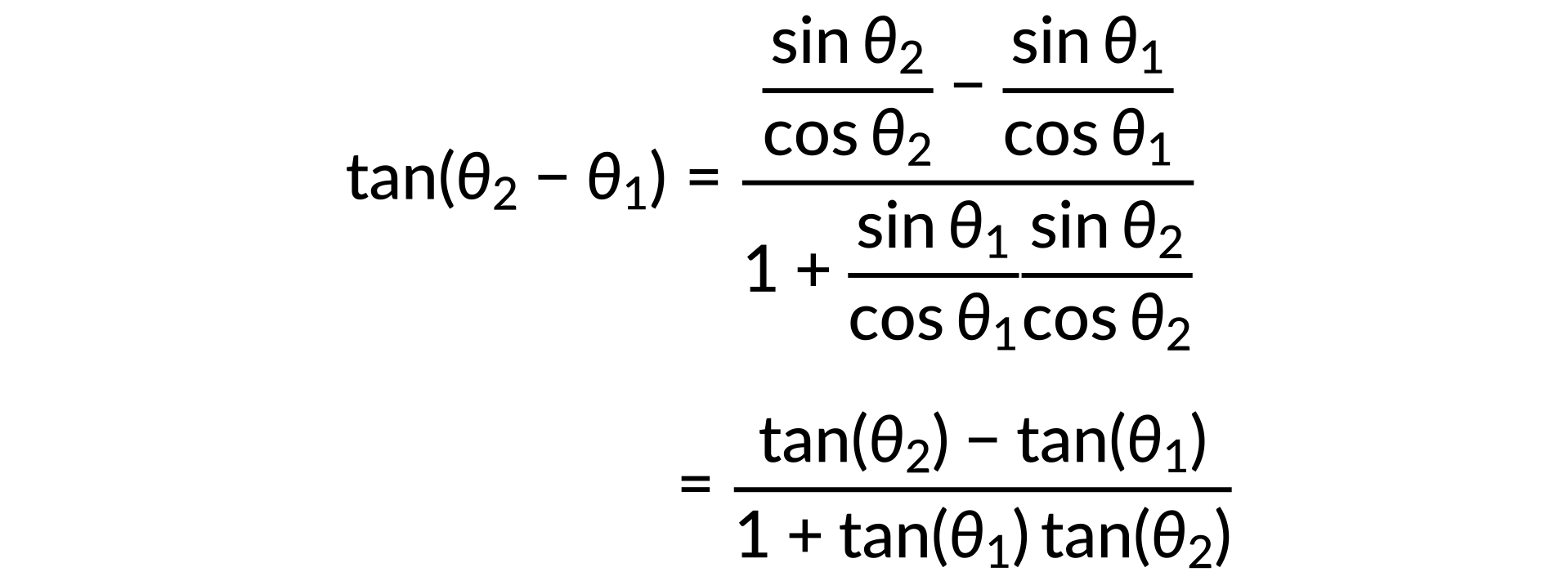
Substituting tan(θ1) = m1 and tan(θ2) = m2:

This angle helps identify how sharply the lines meet, a concept essential in various real-world contexts. For instance, in architectural design, determining the slope or inclination of a roof is vital. A roof with the correct angle ensures efficient water and snow drainage, preventing structural damage. Understanding how inclination works helps engineers and designers make informed decisions about the angles and slopes used in construction, improving functionality and safety.
In mathematics, lines are modeled as having no thickness and extending infinitely in opposite directions.
Their directions are commonly described in two ways: by slope or by inclination. The slope is the ratio of rise to run between any two points on a line.
The inclination is the angle formed with the positive x-axis, measured counterclockwise.
Slope and inclination are connected through the tangent function, which relates the slope to its corresponding angle.
When two lines intersect, the angle of intersection is described as the smaller, acute angle between them.
The intersecting lines and the x-axis form a triangle. Analyzing its interior angles shows that the angle of intersection equals the difference in the lines' inclinations.
Applying a trigonometric identity gives the tangent of this angle, which can also be expressed using the slopes of the lines.
Slopes and inclinations also appear in real-world applications, such as roof pitch, which is usually defined by slope or angle and shows how steep the roof is.
Roof pitch helps water or snow slide off easily, protecting the house from damage.

 繁體中文
繁體中文


